



Real estate investors do not qualify for financing the way a typical homebuyer does, and more of your pipeline is probably made up of these borrowers than it was a few years ago. Self-employed landlords, investors scaling a rental portfolio, and investors whose taxable income is reduced by depreciation and deductions all run into the same wall with conventional underwriting: it is built around personal income, not property income.
The DSCR loan is designed to close exactly that gap, and it is quickly becoming one of the more important tools a broker can offer.
At eLEND TPO, we work with brokers every day who are sitting on investor clients that a purely conventional-only shop would have to turn away. This program is built for exactly that situation.
Run a DSCR scenario with eLEND TPO and see how your borrower’s deal fits.
What Is a DSCR Loan?
DSCR stands for Debt Service Coverage Ratio. A DSCR loan is a type of non-QM investment property financing that qualifies a borrower based on the cash flow the property generates, rather than the borrower’s personal income, tax returns, or employment history.
Instead of pulling W-2s, pay stubs, or two years of returns, the lender compares the property’s rental income to its monthly debt obligation, meaning principal, interest, taxes, insurance, and association dues where applicable.
This matters because a large share of real estate investors do not fit neatly into a conventional debt-to-income box. Self-employed borrowers with heavy write-offs, investors who hold several properties with complex tax situations, and out-of-state buyers assembling a portfolio all tend to look weaker on paper than they actually are financially. DSCR underwriting sidesteps that mismatch by asking a more direct question: does the property pay for itself?
How the DSCR Ratio Is Calculated
The formula itself is simple:
DSCR = Gross Monthly Rental Income ÷ Total Monthly Debt Obligation (PITIA)
| DSCR | What It Means |
|---|---|
| 1.25+ | Strong cash flow, property income comfortably exceeds the payment |
| 1.00 – 1.24 | Property covers the debt and meets eLEND’s 1.00 minimum (loans under $150,000 require 1.25 or higher) |
| Below 1.00 | Property income falls short of the payment and is not eligible for eLEND TPO’s DSCR program |
A Realistic Example
Say your borrower is under contract on a single-family rental at $310,000, with an expected market rent of $2,600 a month. Their estimated PITIA on the new loan comes to $2,150 a month.
$2,600 ÷ $2,150 = a DSCR of about 1.21.
That ratio falls comfortably within a typical qualifying range, and none of it depended on the borrower’s tax returns, W-2s, or existing debt-to-income position. It depended entirely on whether the property supports the payment, which is the entire point of the program.
Why DSCR Loans Are a Growth Opportunity for Brokers
No traditional income documentation required
There are no tax returns, W-2s, or employment verification. Qualification is based on the property, not the person*, which means a lighter documentation lift for both you and your borrower.
*Loans remain subject to credit score, reserves, and LTV requirements.
Repeat business from investor clients
Investors are repeat borrowers. A client who buys one rental property with a DSCR loan is very likely to come back for a second, a third, or a cash-out refinance to fund the next acquisition. That repeat-business dynamic makes DSCR clients some of the most valuable relationships a broker can build.
Access to borrowers conventional programs turn away
DSCR lending opens the door to borrower types conventional programs often cannot reach: LLC-held properties, investors with multiple financed properties, and short-term rental income streams (on refinance transactions) that traditional underwriting was never designed to evaluate.
A simpler path to a clean file
Because the program is underwritten around the property rather than the person, there’s no need to collect and analyze tax returns, pay stubs, or employment history. That lighter income documentation can help files stay organized and moving, which matters for investors competing for properties in fast-moving local markets.
The positioning that works here is straightforward: you are not just a conventional shop. You are a full-service broker who can serve a borrower’s entire real estate strategy, from their primary residence to their fifth rental property, without sending them to a competitor for the deals that do not fit a standard box.
eLEND TPO’s DSCR Investor Program
eLEND TPO’s DSCR Investor Program is built around this kind of flexibility. Key features include:
- No traditional income qualification required
- Purchase, rate/term refinance, and cash-out refinance options
- Long-term rentals are eligible on all transaction types, and short-term rentals on refinance transactions only
DSCR sits alongside the rest of eLEND TPO’s full product lineup, spanning FHA, VA, USDA, conventional, renovation, and manufactured housing programs. A broker who can originate a first-time buyer’s FHA loan and their landlord uncle’s DSCR rental purchase in the same week is offering something a niche non-QM-only shop or a conventional-only bank cannot.
DSCR vs. Other Investor Financing Options
DSCR is not the only path to financing an investment property, and knowing when to steer a client toward DSCR versus another program is part of what makes a broker valuable. Here is how it stacks up against the alternatives you are likely already using.
| Program | Qualifies On | Best Fit For |
|---|---|---|
| DSCR Investor Program | Property rental income vs. debt obligation | Self-employed or high-write-off investors, LLC-held or portfolio investors, short-term rental income (refinance only) |
| Conventional Investment Property | Borrower income, DTI, tax returns | W-2 borrowers with straightforward, well-documented income and a smaller number of financed properties |
| Bank Statement / Alt-Doc | Deposits or P&L in place of tax returns | Self-employed borrowers buying a primary or second home, not specifically investor cash flow |
In practice, a lot of investor conversations come down to one question: does this borrower’s personal financial picture actually reflect what the property can support? If the answer is no, DSCR is usually the more efficient path, both for approval odds and for keeping the documentation manageable.
Common DSCR Borrower Scenarios
The self-employed investor with aggressive write-offs
Tax returns tell a story about tax strategy, not about ability to carry a mortgage payment. Since DSCR underwriting looks at the property’s rent roll rather than the borrower’s adjusted gross income, this is often the single fastest win you can bring to an existing self-employed client who is ready to add a rental property.
The portfolio investor approaching conventional financed-property limits
Conventional financing caps how many properties a borrower can have financed at once, and DTI calculations get more complicated with each additional mortgage on a borrower’s credit report. DSCR takes a different approach: each property is qualified on its own rental income, not stacked against the borrower’s broader DTI picture, which gives growing investors a practical path to keep adding properties.
The out-of-state or short-term rental buyer
eLEND TPO’s DSCR program accepts both long-term and short-term rental income, with one distinction: short-term rentals are eligible on refinance transactions only. Out-of-state buyers can purchase a long-term rental and qualify using the property’s market rent from the appraisal, and investors who already own a short-term rental can refinance it and qualify on its short-term income, rather than being forced to qualify as if it were a traditional long-term lease.
The LLC-held property investor
Many repeat investors hold properties inside an LLC for liability protection. eLEND can close in an LLC, corporation, or partnership.
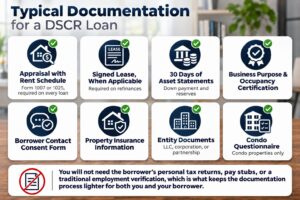
What Documentation Is Typically Involved
Every scenario is different, but a DSCR file typically has a shorter documentation list than a conventional purchase or refinance. Expect to gather:
- An appraisal (Form 1004, 1025, or 1073) with a rent schedule (Form 1007 or 1025), required on every loan
- A signed lease, when applicable: refinances require an executed lease of at least 12 months, or the maximum LTV drops to 70%; on purchases, an existing lease is reviewed if the property is tenant-occupied
- At least 30 days of asset documentation to verify down payment and reserves (6 months PITI on the subject property, or 12 months for first-time investors)
- A signed Borrower Certification of Business Purpose & Occupancy Certification Affidavit
- A Borrower Contact Consent form
- Property insurance information
- Entity documents if the property is held in an LLC, corporation, or partnership
- A Non-QM Condominium Questionnaire for condo properties
What you will not need is the borrower’s personal tax returns, pay stubs, or a traditional employment verification, which is what keeps the documentation process lighter for both you and your borrower.
How to Start Positioning DSCR With Your Borrowers
Adding a program to your toolkit only helps your business if your borrowers and referral partners know you offer it.
- Revisit past declines. Look back at investor files you turned down or referred out over DTI or self-employment income issues. Many of those borrowers are DSCR-eligible today.
- Talk to your referral partners. Realtors and property managers are often the first to hear when a client is ready to buy a second or third rental property.
- Lead with simplicity. Investors respond to messaging about a lighter documentation process and qualifying on the property’s income more than they respond to rate alone.
- Use your channel resources. Review how eLEND TPO structures support for broker partners, including pricing, turn times, and dedicated account executive support, before you start actively marketing DSCR to your pipeline.
Getting Started With eLEND TPO
If you are not yet partnered with eLEND TPO, DSCR is a strong reason to change that. Beyond the DSCR Investor Program, you get access to a full suite of government and conventional products, dedicated account executive support, and a technology platform built to keep files moving.
Frequently Asked Questions
What credit score is needed for a DSCR loan?
eLEND TPO’s DSCR program requires a minimum credit score of 680. Borrowers with scores from 680 to 699 are limited to a maximum 70% LTV, while scores of 700 or higher open up the program’s standard LTV limits. Some scenarios carry higher requirements: first-time investors need at least a 700, and escrow waivers or a prior loan modification require a 720. Reach out to your account executive or submit a scenario through eLEND TPO to confirm the details for your borrower’s file.
Can a DSCR loan close in an LLC or business entity name?
Yes. eLEND can close in an LLC, corporation, or partnership.
Do DSCR loans require tax returns or W-2s?
No. DSCR loans qualify borrowers based on the property’s rental income relative to its debt obligation, not personal income documentation like tax returns or W-2s.
Can a DSCR loan be used for a short-term rental property?
Yes, on refinance transactions. eLEND TPO’s DSCR Investor Program allows short-term rental properties on refinance transactions only.
Is a DSCR loan only for purchases, or can it be used to refinance?
eLEND TPO’s DSCR program supports purchase, rate/term refinance, and cash-out refinance transactions, so it can be used both to acquire new investment properties and to refinance existing ones.
Can borrowers with multiple financed properties use a DSCR loan?
Yes. eLEND TPO’s DSCR program qualifies each property on its own rental income rather than the borrower’s overall debt-to-income ratio, so investors with multiple financed properties are eligible. Keep in mind that a DSCR mortgage still shows as a financed property on the borrower’s credit report, so it may count toward financed-property limits if the borrower later applies for a conventional investment loan.
Common Misconceptions About DSCR Loans
“DSCR loans are only for experienced investors.” Not true. eLEND TPO’s DSCR program is open to first-time investors buying their first rental property, as long as they meet a few additional requirements: a minimum 700 credit score, 12 months of reserves, a 12-month housing payment history, 36 months of seasoning from any credit event, and a maximum 75% LTV. First-time investors must also currently own a primary residence, and first-time homebuyers are not eligible.
“DSCR loans are only for single-family rentals.” eLEND TPO’s program is not limited to one property type, and long-term rental income is eligible on all transaction types and short-term rental income on refinance transactions, which covers a much broader range of investor scenarios than a single-family-only program would.
“This is a niche product that will not move the needle.” Given how much of the current market is made up of repeat and portfolio investors, DSCR is quickly becoming a core part of many brokers’ business rather than a side offering.
Run a Scenario
Every borrower scenario is different. The best next step is to run the numbers and see how a specific deal fits eLEND TPO’s current guidelines.
Try the Quick Pricer →
Apply to Become a Partner →
Program notes: eLEND TPO’s DSCR program is available to U.S. citizens and permanent resident aliens financing investment properties only. Geographic restrictions apply in Hawaii, New York, Philadelphia County, PA, and Baltimore City, MD, and maximum LTVs are lower in Connecticut, Illinois, and New Jersey. 2–4 unit properties are not eligible in Illinois, and condominiums must be warrantable. Power of attorney is not permitted on cash-out transactions or when closing in an entity’s name. See the DSCR program matrix and underwriting guidelines for complete requirements.
Lender NMLS: 2826. Trade/Service marks are property of American Financial Resources, LLC DBA eLEND. Trade names may vary by state. For more information visit www.nmlsconsumeraccess.org. This does not constitute an offer for extension of credit or a commitment to lend. Some products may not be available in all states. Restrictions apply and terms are subject to change without notice. All loans subject to credit approval. This information is provided to assist real estate professionals only and is not an advertisement extended to consumers as defined by Regulation Z. Equal Housing Lender.